
Child Development
The Seven Areas of the EYFS: What They Actually Look Like at The House That Jack Built
Written by Margaret, Owner & Director at The House That Jack Built
Parents often ask me some version of the same question: "I know the nursery follows the EYFS, but what does that actually mean for what my child does each day?" It is a fair question. The Early Years Foundation Stage statutory framework sets out the learning and development standards that all early years providers must follow, but the framework itself can feel quite abstract when you are trying to picture your two-year-old's Tuesday morning.
So here is my attempt to make the EYFS areas of learning explained in a way that actually connects to what I see happening at our nurseries every single day.
The Seven Areas: A Quick Map
The EYFS divides learning into seven areas: three prime areas and four specific areas. The prime areas come first because they form the foundation everything else builds on. They are:
- Communication and Language
- Physical Development
- Personal, Social and Emotional Development
The four specific areas sit alongside them and broaden children's learning further:
- Literacy
- Mathematics
- Understanding the World
- Expressive Arts and Design
Think of the prime areas as the soil and the specific areas as what grows in it. You cannot have one without the other.
What the Prime Areas Look Like Here
Communication and Language is probably the area parents see most clearly, because they hear it happening at pick-up. At our Marlow Bottom setting, I often watch a child narrate exactly what they are doing in the mud kitchen, or a baby in the Hazlemere babies' room respond to a familiar voice with a broad, delighted look. We build language through conversation, stories, songs and plenty of unhurried time for children to find their words. Circle time gives every child a moment to be heard. Our key carers learn each child's individual pace, so quieter children are gently drawn in rather than talked over.
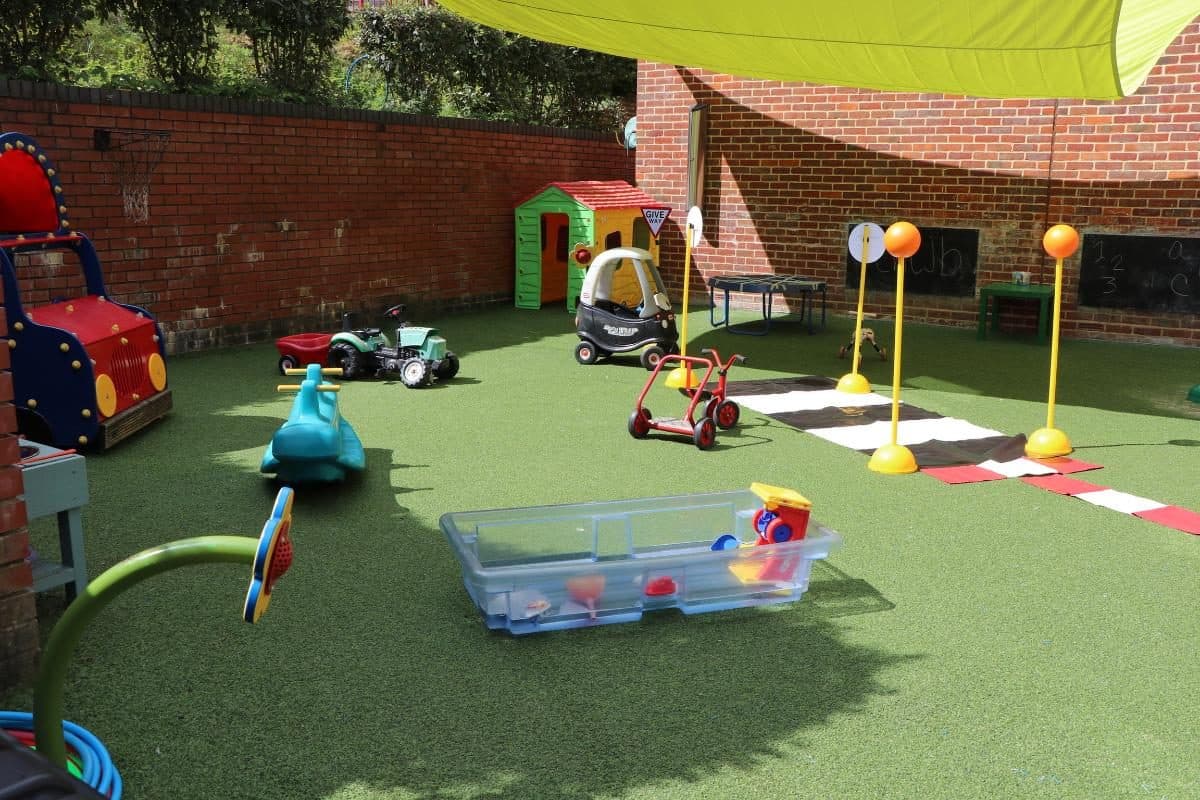
Physical Development covers both the large movements, running, climbing, balancing, and the finer skills like holding a paintbrush or doing up a button. Our free-flow system means children move between indoors and outdoors throughout the day in all weathers, which makes physical development a constant rather than a scheduled slot. I would say the garden is probably the hardest-working part of our nurseries.
Personal, Social and Emotional Development is, in my experience, the area that matters most to parents of younger children, and rightly so. This is where children learn to manage feelings, build friendships, separate from a carer, and begin to understand their own needs. Every element of how we work, the key person system, our calm and consistent approach to behaviour, the settling-in process we use before a child even starts, is designed to support this area. You can read more about how we approach the social side of nursery life in our post on how nursery life helps young children learn to get along.
What the Specific Areas Look Like Here
Literacy is not about teaching three-year-olds to read. It is about building a genuine love of books and an ear for language, noticing print in the environment, enjoying stories and beginning to make marks with real purpose. We embrace books as a starting point for all kinds of learning. I have seen babies in our nurseries exploring sensory textures connected to a favourite story, feeling foam and rice that bring the pages to life. That kind of early experience is what makes reading feel meaningful later on.
Mathematics in the early years is about pattern, shape, quantity, space and number, all of which children encounter naturally when they are playing. Laying the table for lunch, sorting conkers collected on a walk near Marlow Bottom, sharing out the playdough: these are genuinely mathematical moments, and our key carers know how to name and extend them without turning them into lessons.
Understanding the World covers science, history, geography, people and communities, and technology, which sounds ambitious for a toddler, but it is really about curiosity and noticing. At our Hazlemere setting, our outing to the nearby park is an Understanding the World activity every bit as much as a physical one. Children are looking at seasons changing, spotting minibeasts, talking about what they can see and smell. Our growing areas at both settings mean children follow produce from seed to plate, which connects beautifully with this area and with our food culture too.
Expressive Arts and Design gives children space to create, experiment and imagine. Painting, music, dance, construction, small world play, dressing up: all of it belongs here. I find this area is where children often surprise you. Give a child open-ended materials and enough time, and what they produce tells you a great deal about how they are thinking.
EYFS Areas of Learning Explained: The Bigger Picture
What I want parents to take from this is that the seven areas are not seven separate lessons happening at seven separate tables. At The House That Jack Built, they happen simultaneously, woven through a day that flows freely between spaces, activities and relationships. A child building a den in the garden might be developing physical skills, negotiating with a friend, narrating their plan aloud, counting the sticks they need and noticing that the light has changed since this morning. That is five areas at once, with nobody calling it a lesson.
Our key carers observe all of this, note what they see, and use it to plan what each child needs next. That is how the EYFS is meant to work, and it is what we try to do well every day across our Marlow, Hazlemere and High Wycombe-area settings.
If you would like to see it in action, come and look around. We would be glad to show you what a free-flow day actually feels like. Book a show-around at whichever of our settings is most convenient, and we can talk through what your child's day would look like in practice.
Come and see us for yourself
Book a relaxed tour of The House That Jack Built and meet our team.
Book a tourOther guides you might like
Child Development
Why Mixed-Age Learning Works: What We See Every Day at Our Nurseries
Mixed-age groups are something we have always believed in at The House That Jack Built. Here is what we genuinely observe when younger and older children learn alongside one another.
Child Development
Sleep, Rest and Development: What We See at Nursery Every Day
Sleep is one of the quieter but more powerful parts of a young child's development. Margaret, Owner and Director at The House That Jack Built, shares what she and her team observe day to day across their Marlow, Hazlemere and High Wycombe nurseries.
Child Development
How nursery life helps young children learn to get along
Social skills don't arrive fully formed — they develop gradually through everyday moments of play, conflict and connection. Here's how we support that process at The House That Jack Built.
Frequently asked questions
What are the seven areas of learning in the EYFS?
The EYFS has three prime areas: Communication and Language, Physical Development, and Personal, Social and Emotional Development. These sit alongside four specific areas: Literacy, Mathematics, Understanding the World, and Expressive Arts and Design. Together they cover all aspects of a young child's learning and development from birth to age five.
Do nurseries have to follow all seven areas, or can they choose which ones to focus on?
All early years providers registered to deliver the EYFS must cover all seven areas of learning. However, they develop their own approach to doing so. At The House That Jack Built, we weave the areas together through free-flow play, outings, circle time and daily routines rather than delivering them as separate activities. Each child's key carer tracks progress across all seven.
How does The House That Jack Built's free-flow approach support EYFS learning?
Our free-flow system lets children move between indoor and outdoor spaces throughout the day, following their own interests and ideas. This means learning across all seven EYFS areas happens naturally and simultaneously rather than in timetabled slots. A child playing outdoors might be developing language, physical skills and mathematical thinking all at once, with their key carer observing and building on what they see.
Can I come and see how the nursery puts the EYFS into practice?
Absolutely. The best way to understand how we work is to see it for yourself. We welcome families from Marlow, Hazlemere and the surrounding areas for a relaxed look around. Book a show-around and we will walk you through a typical day, show you the spaces your child would use, and answer any questions you have.